Above the tunnels and caves of The Underground Man
I first came across the fifth Duke of Portland in Bill Bryson’s Notes from a Small Island. As part of Bryson’s valedictory tour of Britain he walks from Worksop to the family seat of the Dukes of Portland at Welbeck Abbey. The Duke he describes is a model of English eccentricity: a reclusive life, meals delivered by tiny railway, communication through notes passed through letterboxes and an extensive collection of brown wigs. I was intrigued.
A less sensational account of the Duke in a booklet I picked up from the Harley Gallery (built in the ruins of the Welbeck Estate’s former gas works), describes a generous man with a passion of construction who embraced new technologies, including horticultural advances that allowed pineapples and other tropical fruits to be grown on the estate. But it is for the miles of underground carriage drives he built that he is best known.
The Duke is the jumping off point for Mick Jackson’s wonderful Booker nominated novel The Underground Man. As Jackson acknowledges, he soon departs from the real-life Duke. Jackson’s Duke is certainly eccentric, but is also deeply human, suffering the effects of long-buried trauma. He views the world with a child-like wonder, imagining fantastical explanations for phenomena he observes. And, like me, he is also a cartophile, so I can’t help feeling a degree of empathy with him.
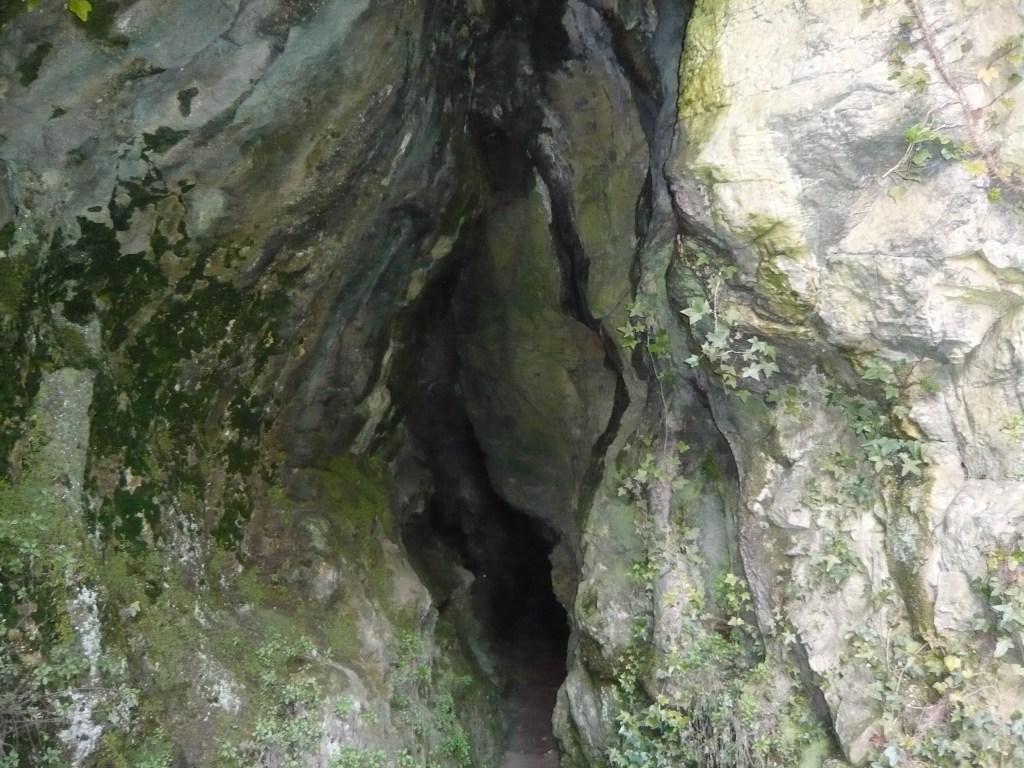
As well as enjoying drives and strolls along his own tunnels, this fictional Duke visits the Pin Hole cave at nearby Creswell Crags (the image above is the entrance to Pin Hole cave). He is accompanied by the parish priest, an amateur archaeologist, who is surprised the Duke has never visited the caves on his estate: “And you being such an underground man”. After an uncomfortable and claustrophobic crawl into the cave, the Duke is mesmerised by the beauty within, the crystal in the rocks picked out by light from a tiny natural chimney. After his adventure in the dark and cramped caves, the Duke emerges to view the outside world with renewed appreciation.
“The view from the cave entrance, though frosty and wintry, was a marvel to behold – full of colour and distance and depth.”
The Underground Man, Mick Jackson
The Duke’s tunnels were illuminated by plate-glass skylights. The OS mapping shows lines of ‘tunnel skylights’ still radiating from the Abbey, including along the line of the Robin Hood Way – a walking route that meanders its way across Nottinghamshire. I’ve explored the skylights before about a decade ago, but this blog gave me the perfect excuse for a return.
Ramble #4
Map and route: OS Explorer Map 270. I’ve plotted the route I took here.
Distance: 10 miles
Timing: 5 hours, including a leisurely picnic, taking photographs and exploring Creswell Crags.
Start: Car park at The Harley Gallery at Welbeck SK 548 741. I can recommend a visit to the Gallery – it houses part of the Portland Collection and changing exhibitions of contemporary art.
Description:
From the car park, head back along the drive. Just before the road, turn right onto a lovely cream stone path. I walked this route in early March and the roadside verges were carpeted with clusters of snowdrops. The path follows the road a short distance before joining a wide track and public footpath, part of the Robin Hood Way. Turn right onto the track. At a crossing of tracks by a gatehouse, continue straight ahead climbing slightly, following the track as it bends around to the right. Turn left at the edge of woodland and follow the fence line.
On reaching another track, turn right continuing to follow the fence. Shortly you come to an entrance to the former Abbey on your right. Keeping to the Robin Hood Way, turn left following the signpost then turn left again over a cobbled bridge across the lake.
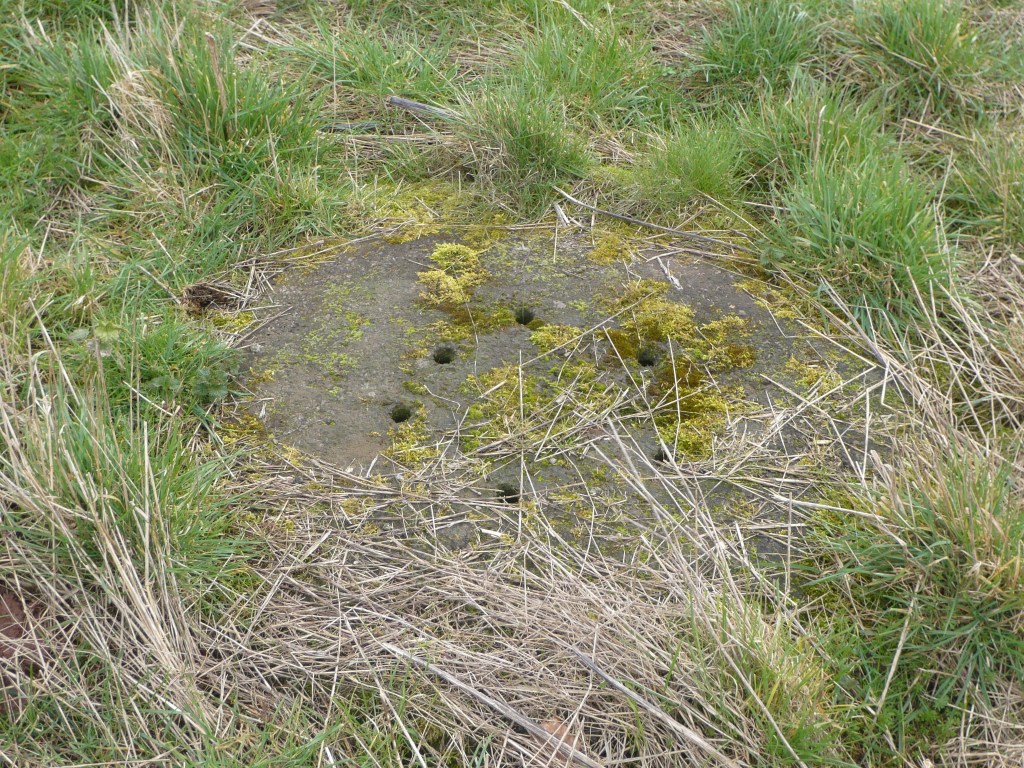
On the other side of the bridge you emerge into a wide, open field. Here the line of one of the Duke’s tunnels can be made out running alongside the path. The skylights are capped with concrete, and overgrown with moss and grass. Some of the skylights are visible only as vague depressions in the earth. I stood on one of the caps and tried to imagine the view from inside the tunnel below.
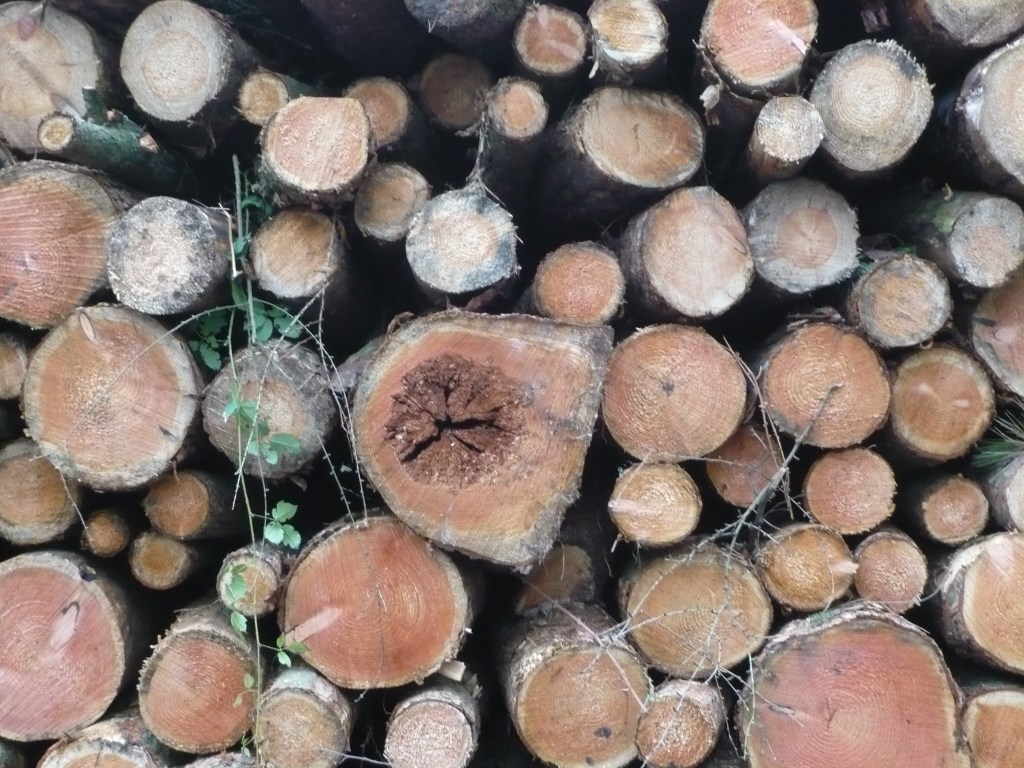
Follow the footpath to reach South Lodge on the far side of the field. Pass in front of the dwellings. Don’t follow the RHW to the right but turn left then right through a gate with a lovely latch to follow the footpath signposted for Worksop. The path runs through open woodland and then through a conifer plantation on the edge of the Manor Hills. Stacks of freshly cut timber lined the route. Emerge from the trees onto a straight, sandy track that points towards the grey pile of Worksop Manor in the distance.
Follow the track to a junction, then turn left along a grassy hedge-lined path. A charm of goldfinches accompanied me along this section, flitting in and out from the hedges just in front of me. At the end of the track, turn left and then right almost immediately, crossing a stream at the edge of a stand of trees. Follow the field boundary of two fields then, at a finger post, enter the field to your right and cross diagonally. Go through a gap in the hedge, over a plank bridge across a ditch, then cross the next field to reach the A60 Mansfield Road.
Cross over and continue straight up the opposite field to Birks Cottages. Pass through the gate ahead, follow the track between the houses and climb the stile ahead where the track bends left. Follow the path around to the left of Birks Farm to another track, then turn right following the yellow waymarks. Continue ahead across fields (there was construction work taking place at the time of my walk, so they may not be fields for much longer) to reach the railway. Cross the railway, then another field to reach houses on the edge of Whitwell. A short walk through the edge of the village is needed to join up to the return loop of the walk.
Follow the path between houses to come out at the end of a cul-de-sac. A short way down the road, turn left to go through a gitty. Head downhill to the main road. Cross over and turn left. After the shops, turn right to follow a path along the edge of a playground and then behind gardens to the railway station.
Cross the road and follow the path ahead to the car park. Continue to follow the signposted footpath that runs parallel to the railway line. When you reach the road, turn right then left into the industrial estate. This may not look very promising but shortens the road walking. Squeeze through a rubbishy gap in the top corner of the car park into an area of grass and trees. Turn left, following the footpath downhill. Follow the path as it bends around to the right back alongside the railway line. The path climbs uphill and continues above the line of the railway as it passes through the hillside below. Another tunnel!
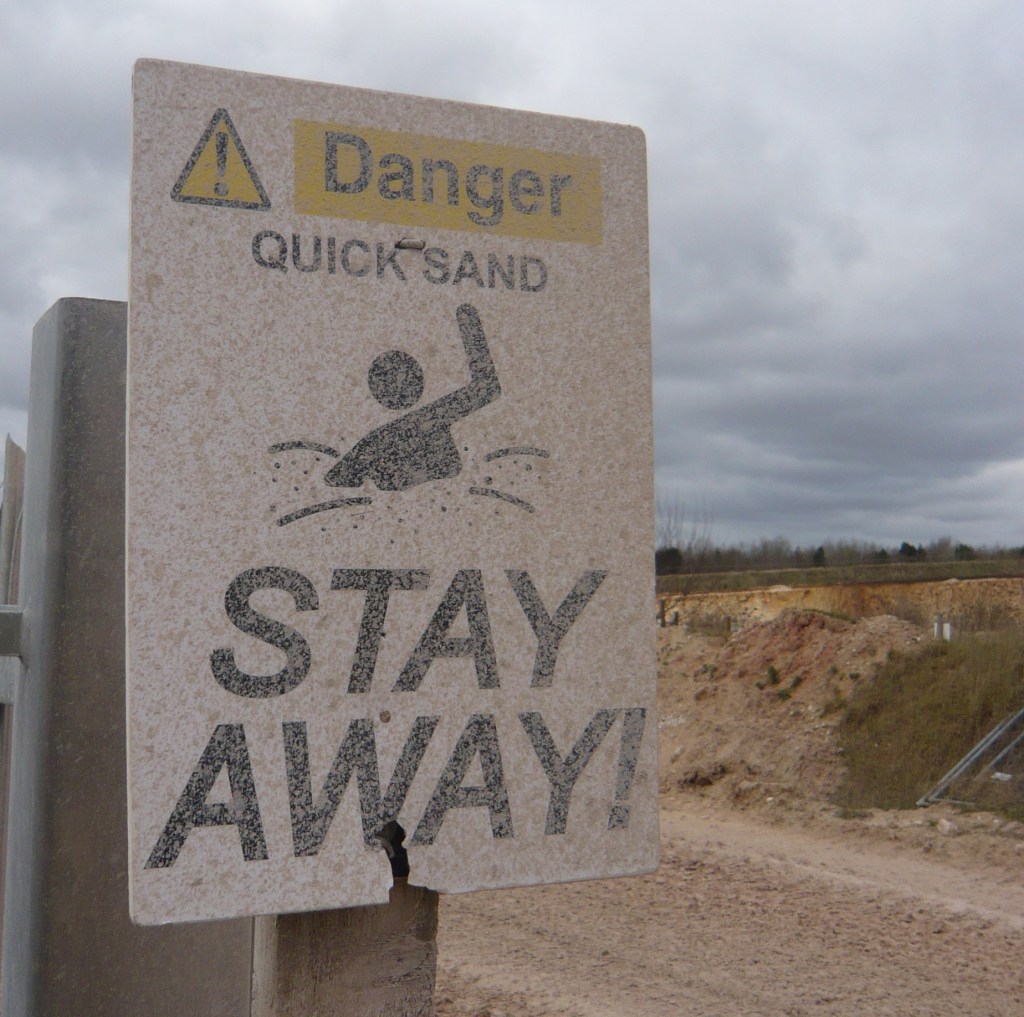
Either side of the embankment is a limestone quarry. Cross the quarry access road, noting the somewhat ambiguous sign warning of quicksand – is this person waving, or drowning? I have a fondness for these types of warning sign that depict some hapless bod in an unlikely pose – falling head first off a cliff, or pinned down by giant zig-zagging arrows. They always make me chuckle – probably not the intention.
Turn left at the junction of paths and walk downhill on the opposite side now of the railway. At the bottom of the slope is a handy bench with a view across wide rolling farmland where I sat and ate my sandwiches.
Turn left and follow the edge of the field to the very end, then turn left again to follow a path running parallel to the road, where it eventually emerges. Cross over and double back along the road a short way then turn left down the side road to arrive at Creswell Crags.
There’s a small visitor centre and exhibition at the Crags, along with café and toilets. It’s worth taking a walk, as I did, around the boating pond that now sits between the crags. The cave entrances are locked, but tours of some can be booked.
Returning to the visitor centre, walk through the car park away from the Crags to join a footpath. This leads back to the road near the start of the walk. Cross over and turn right, following the cream stone path back to the garden centre and Harley Gallery.
Verdict: A fairly easy if not particularly short walk through gently rolling countryside with plenty of points of interest to stop and explore along the way. In The Underground Man, the Duke reports that a stroll along his tunnel to Creswell is “a grand walk” and on returning that he will “sleep like a top”. Both sentiments would apply to this above-ground ramble.
 A Reader's Rambles
Leave a comment